What Is Shadow AI? Risks, Examples and Enterprise Mitigation
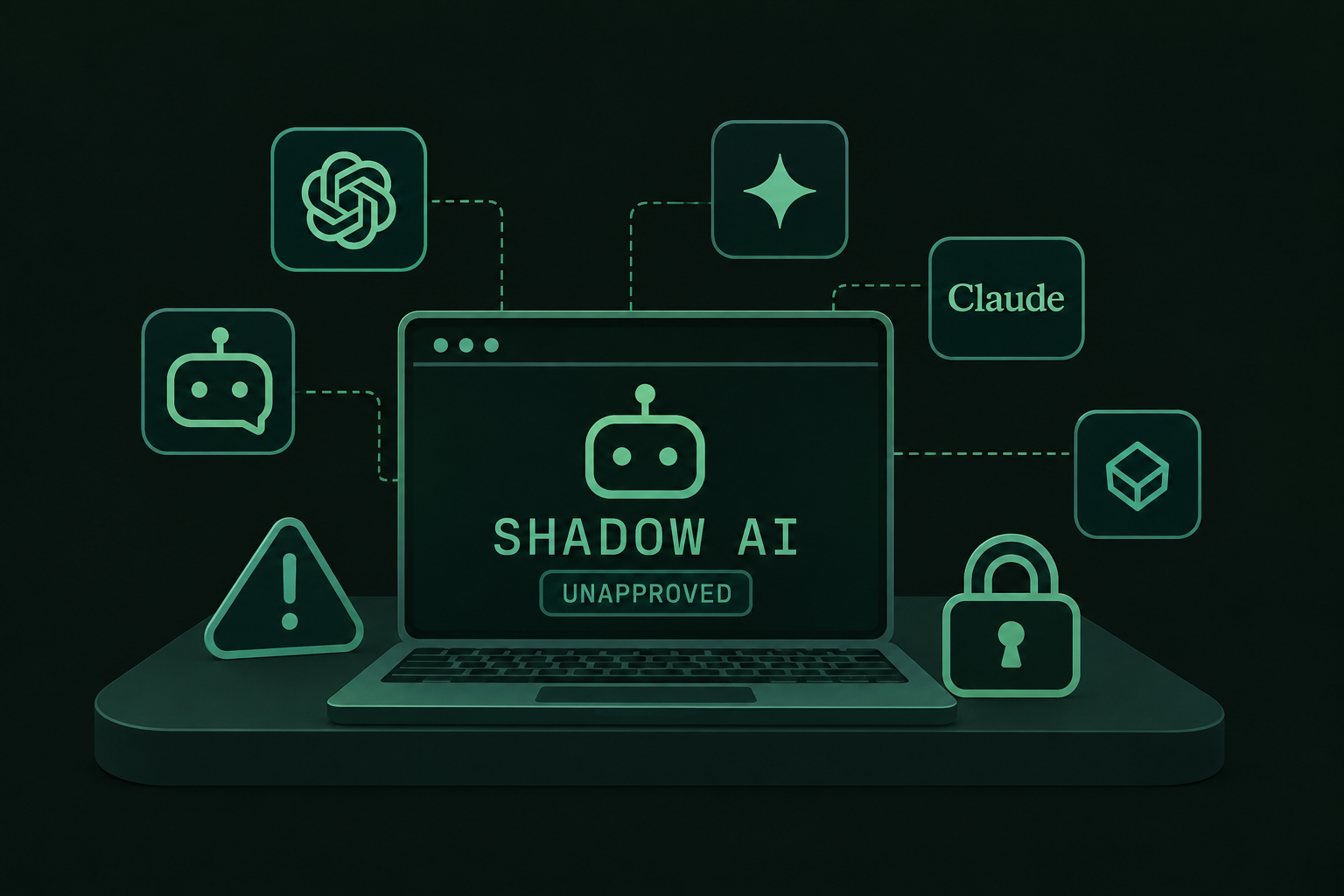
Shadow AI is any AI tool an employee uses for work that IT never approved, never configured, and doesn't know exists. Not a hypothetical category. It's running inside your organization right now, on devices you issued, during work hours, done by people who aren't trying to cause a problem.
It's the fastest-growing blind spot in enterprise IT, and it didn't exist in this form three years ago.
Why shadow AI is different from shadow IT
Shadow IT — employees using unapproved software, from Dropbox to Trello — has existed for two decades. Companies built entire security categories around finding and controlling it.
Shadow AI moves faster, for one structural reason: there's nothing to install. Shadow IT required downloading an app, creating an account, sometimes even a company card to pay for it — friction that gave IT teams a chance to notice. Shadow AI requires opening a browser tab. ChatGPT, Claude, Gemini, Perplexity — all free tier, all accessible in under ten seconds, often poorly understood by security controls that were designed for traditional applications and file transfers, rather than AI-specific usage and prompt-level data flows.
That's the core problem: most enterprise security stacks were architected to catch app installs and file transfers, not conversational queries typed into a browser. Shadow AI slips through a gap that wasn't there when the tooling was designed.
What shadow AI actually looks like inside a company
Not a rogue employee doing something reckless. The opposite — it's usually your best people, working efficiently.
- A sales rep pastes a prospect's contract terms into ChatGPT to draft a counter-proposal faster.
- An engineer copies a proprietary code snippet into Claude to debug a production issue at 6pm.
- An HR manager uploads anonymized-in-their-mind employee performance data into Gemini to draft review summaries — except the data isn't actually anonymized.
- A finance analyst feeds unreleased quarterly figures into Perplexity to check how a competitor phrased something similar.
None of these people think they're doing anything wrong. They're solving a problem, fast, with a tool that's sitting right there. That's exactly what makes shadow AI hard to stop with policy alone — the behavior isn't malicious, it's rational, and it happens under normal work pressure, not edge cases.
Why it's a bigger risk than most companies assume
No audit trail. When sensitive data reaches an external AI service, it may trigger international data-transfer requirements under GDPR Chapter V — often without the organization having assessed the transfer, because it may not even know the AI tool was used. You cannot assess a data flow you don't know exists.
Confidentiality breach exposure. NDAs, client contracts, and supplier agreements routinely include confidentiality clauses that don't carve out "unless an employee pastes it into a chatbot." Legal teams are only beginning to catch up to what this means in practice.
It compounds, not stays static. Shadow AI usage grows every quarter a company doesn't address it, because more tools launch, more employees discover them, and the behavior normalizes across teams that watch colleagues do it without consequence.
Why blocking doesn't work
The obvious-seeming fix — block ChatGPT and its peers at the network level — fails for a reason most IT teams discover only after trying it: employees route around it. Personal devices, mobile data, browser extensions built specifically to bypass corporate filters. Blocking doesn't eliminate the behavior, it just removes your visibility into it — the worst possible outcome, because now the same risk exists with zero logging at all.
There's also a business cost to blocking that's easy to underweight: these tools genuinely make people faster. An outright ban pushes the most productive employees toward the highest-friction workaround, while doing nothing to the majority who'll simply find another tab.
Shadow AI is not fundamentally an employee problem. It's an infrastructure problem. Employees will use the tools that help them work faster. The governance layer has to make that behavior safe, visible and auditable — without asking people to stop being productive.
What actually reduces shadow AI risk
Not policy. Not training sessions, though those help marginally. Three things, working together:
- Visibility first. You can't govern what you can't see. Before anything else, an organization needs an accurate, continuously updated picture of which AI tools are actually in use — not the list IT approved, the list employees are actually opening.
- Protection at the point of use. Real-time interception that tokenizes or masks sensitive data before it reaches an external model — not a policy asking someone to remember not to paste something, a technical control that acts regardless of whether they remember.
- Evidence, continuously. A log of what happened — who, what tool, what category of data — retained in a form that holds up when a DPO or regulator asks for it.
This is the same three-part structure that defines AI governance more broadly — shadow AI is simply the sharpest, most immediate example of what happens when an organization has none of the three.
The question every security leader is asking wrong
Most conversations about shadow AI start with "how big is our exposure" — as if it's a number to estimate. It isn't. It's a visibility problem to solve. The question isn't "do we have a shadow AI problem." Any organization with employees and internet access does, by definition. The only real question is whether anyone can currently see it.
Colchix gives regulated enterprises real-time visibility into shadow AI usage — which tools, which employees, which data — before it becomes a compliance incident.
See how ARGUS works →