AI Act vs GDPR: What Actually Changes for Enterprises
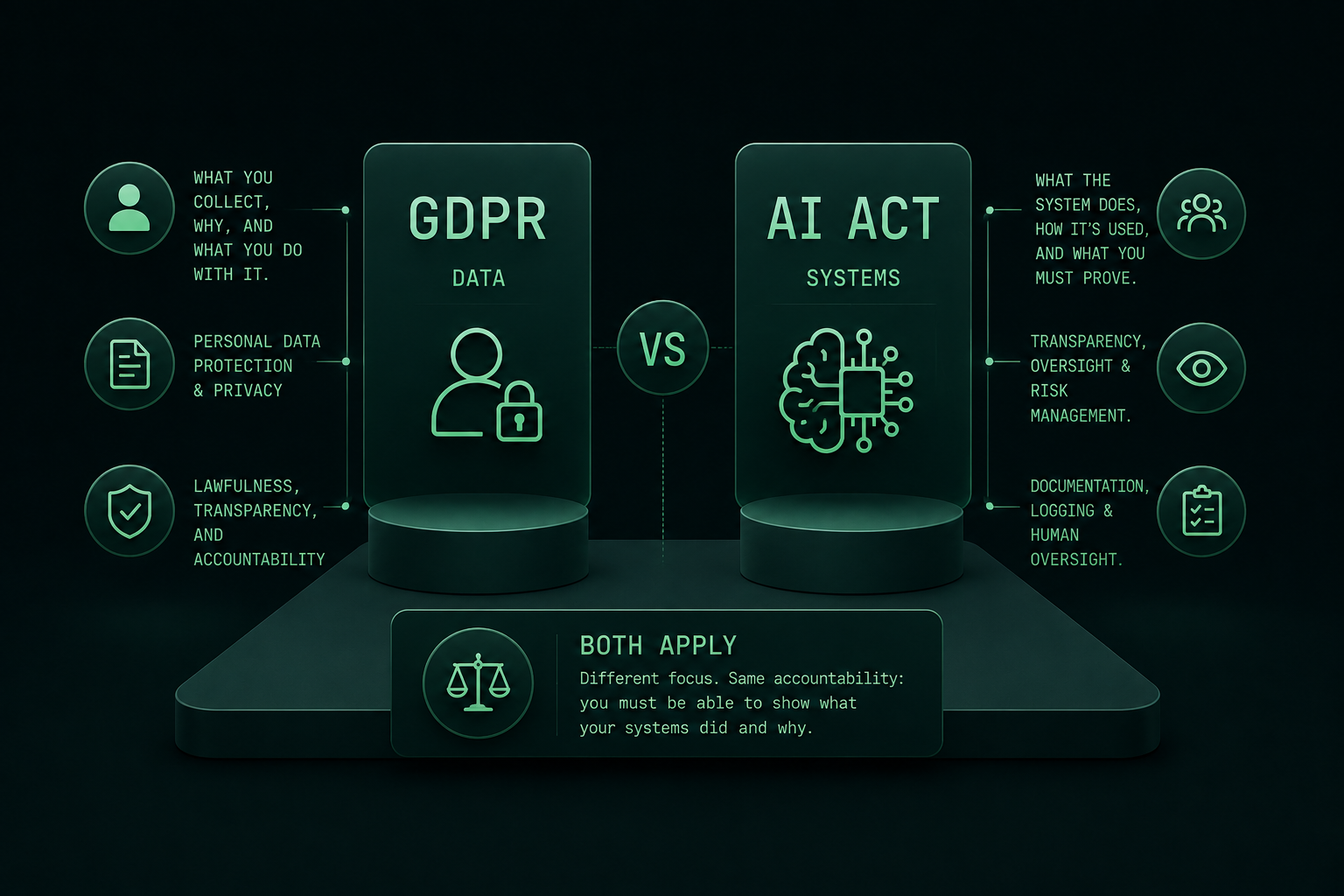
GDPR and the AI Act are not the same regulation with a new name attached. GDPR governs personal data — what you collect, why, and what you do with it. The AI Act governs systems — what an AI system does, how much oversight it needs, and what you have to prove about how it behaves. A company can be fully GDPR-compliant and still be exposed under the AI Act. Most compliance programs built before 2024 don't yet reflect that.
The core distinction, in one sentence
GDPR asks questions about data. The AI Act asks questions about systems.
If your organization processes personal data through an AI tool, both laws apply simultaneously, to different parts of the same activity — and they don't automatically satisfy each other. A GDPR-compliant data processing agreement with a vendor says nothing about whether the AI system itself meets the AI Act's transparency or oversight requirements.
Where GDPR still does the heavy lifting
For most AI use cases inside a regulated enterprise today, GDPR remains the more immediately enforceable framework, because it's mature, well-understood, and has been tested in courts and by data protection authorities for years.
GDPR governs an AI interaction the moment personal data is involved — a customer's name in a support ticket, an employee's performance data in an HR tool, a client's contract details pasted into a drafting assistant. Article 25 (privacy by design) and Article 30 (records of processing) are the two provisions that matter most in practice: they require that data protection is built into the process, not bolted on, and that organizations can produce a record of what processing actually took place.
This is where the disconnect between policy and reality shows up first. An organization can have a GDPR-compliant privacy policy and a signed DPA with every AI vendor it officially uses, and still have zero visibility into what happens when an employee pastes personal data into a consumer AI tool nobody approved. The policy is compliant. The behavior isn't covered by it.
Where the AI Act adds a genuinely new layer
The AI Act doesn't replace GDPR's focus on personal data — it adds obligations that are independent of whether personal data is involved at all. A system can be entirely GDPR-compliant (no personal data touched) and still fall under AI Act obligations, because the AI Act cares about the system's function and risk classification, not just the data flowing through it.
Two obligations matter most right now for enterprises:
Article 4 — AI literacy. Applicable since February 2025, this requires providers and deployers of AI systems to take measures to ensure a sufficient level of AI literacy among relevant staff, taking into account their technical knowledge, experience and the context in which the systems are used.
Article 50 — transparency. Applicable since 2 August 2026, Article 50 introduces specific transparency obligations for certain AI systems and AI-generated content — including informing people when they are interacting with AI, and disclosure requirements for deepfakes and certain AI-generated public-interest content.
What's not currently in force, and gets misrepresented constantly in vendor marketing: the high-risk system obligations under Annex III. Following the 2026 AI Omnibus, application of the high-risk rules for Annex III systems has been extended to 2 December 2027, while rules for high-risk AI embedded in regulated products under Annex I apply from 2 August 2028. If you're evaluating vendors and one is running urgent "AI Act deadline" messaging tied to August 2026 for Annex III-scope obligations, that's worth double-checking against the current timeline before it shapes a budget decision.
Source: European Commission — AI Act · Guidelines on transparency obligations (Article 50)
The overlap that actually matters: accountability
Both frameworks converge on the same underlying demand, expressed differently: you must be able to show, on request, what your systems did and why.
GDPR calls this accountability (Article 5(2)) and demonstrable compliance. The AI Act calls it technical documentation, logging, and human oversight. Different vocabulary, same operational requirement — a real-time record of AI activity that holds up when someone asks for it, not a reconstruction assembled under pressure after an incident.
This is the practical reason treating GDPR and the AI Act as two separate compliance projects is inefficient. The underlying evidence infrastructure can support both frameworks. A technical record of which AI system was used, when, under whose authority, and with which categories of data can support GDPR accountability while also contributing to AI Act logging, transparency, and oversight requirements where applicable.
What this means for a compliance program in practice
A few concrete implications, if you're mapping this to an actual program rather than reading it as theory:
- A DPA with your AI vendor covers GDPR obligations for that specific tool. It says nothing about shadow AI use of tools you don't have a DPA with — which is most of what employees actually use day to day.
- AI literacy (Article 4) is a current, active obligation, not a 2027 concern — if your organization hasn't documented how it's meeting this, that's a gap that exists today, independent of the Annex III delay.
- Evidence infrastructure can serve both frameworks at once. A log that captures which employee used which AI tool, with what category of data, and when, contributes to GDPR processing-record evidence and AI Act oversight documentation alike.
- "We have a DPA" is not the same claim as "we're AI Act compliant." They're answers to different questions, and a DPO who can only answer the first one has a real, current gap — not a hypothetical future one.
The bottom line
GDPR tells you how to handle personal data responsibly. The AI Act tells you how to operate AI systems responsibly. An enterprise using AI at any scale is subject to both, and building compliance infrastructure for one without the other leaves a real gap — one regulators are increasingly positioned to notice, given how much overlap exists between what both frameworks actually ask an organization to prove.
Colchix generates audit-ready evidence designed to support both GDPR accountability and AI Act oversight — from the same runtime governance layer, not two disconnected compliance projects.
See how Athena works →