What Is AI Governance? A Practical Definition for Regulated Enterprises
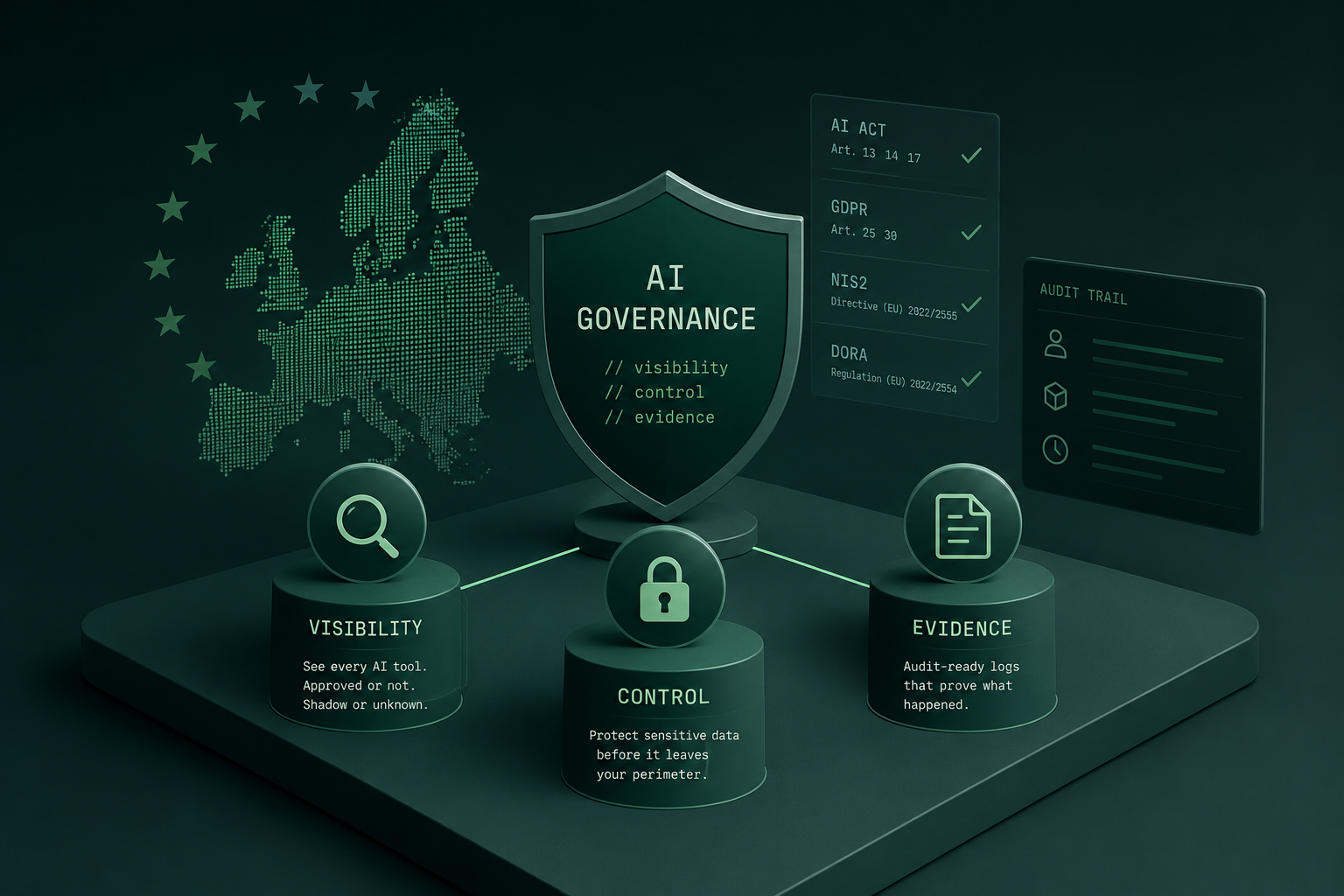
AI governance is the ability to see which AI systems your organization actually uses, control what data reaches them, and prove both of those things to a regulator on demand. Not a policy. Not a training session. A technical capability.
Most companies don't have it. They have a document.
The definition everyone gets wrong
Search "AI governance" and you'll find a hundred variations of the same vague sentence: "a framework of policies and practices to ensure responsible AI use." True, and useless. It tells you nothing about what governance actually requires you to build.
Here's the version that holds up in an audit:
AI governance is the combination of three technical capabilities — visibility, control, and evidence — applied to every AI system your organization touches, whether you approved it or not.
- Visibility: knowing which AI tools are in use, by whom, with what data — including the ones IT never approved.
- Control: the ability to intervene before sensitive data reaches an external model, not after.
- Evidence: logs and records that prove the first two points happened, in a format a regulator or auditor will accept.
Remove any one of the three and you don't have governance. You have an intention.
Why "we have a policy" isn't governance
A policy is a sentence in a PDF that says employees shouldn't paste client data into ChatGPT. It has never once stopped an employee from doing exactly that at 4:47pm on a Friday, under deadline, with no bad intent — just work that needed to get done.
This isn't a hypothetical. Internal studies on shadow IT consistently show the gap between written policy and actual behavior is enormous, and AI tools have made it worse, not better, because the barrier to use dropped to zero. No install, no approval, no IT ticket — just a browser tab.
Governance that lives only on paper fails the moment it meets a real deadline. Governance that lives at the infrastructure level doesn't need the employee to remember the rule, because the rule enforces itself.
Governance vs. security: not the same thing
These get conflated constantly, and the confusion costs companies real time in vendor selection.
AI security asks: is this model safe from attack, manipulation, or jailbreaking? It protects the model itself, and it matters most for organizations building or fine-tuning their own models.
AI governance asks a different question: what happens to our data when our employees use any model, ours or someone else's? It's not about hardening a model — it's about controlling what flows in and out of it, and being able to prove that control existed.
A company can have excellent AI security and zero AI governance. It happens constantly: a well-secured internal AI product, sitting next to a workforce that pastes contract drafts into public ChatGPT with no oversight at all.
What regulated enterprises specifically need to govern
If you're in fintech, banking, insurance, healthcare, or manufacturing operating in Europe, governance isn't optional reading — it's already a legal obligation layered across multiple frameworks that don't fully overlap:
- GDPR — governs any AI use that touches personal data, regardless of which model processes it
- The EU AI Act — general-purpose obligations under the Act, including Article 4's AI literacy requirement (in force since February 2025), apply regardless of sector; the high-risk Annex III obligations, meanwhile, were pushed to December 2027 following the Digital Omnibus proposal (May 2026) — a detail that gets lost in most vendor marketing still running August 2026 deadline messaging
- NIS2 — brings AI tooling into scope as part of supply-chain and operational risk, particularly relevant if AI tools touch systems classified as essential or important entities
- DORA — for financial institutions, extends operational resilience requirements to AI-driven processes
None of these frameworks tell you how to build governance. They tell you what you'll be asked to prove exists, after the fact, when something goes wrong.
The part most companies skip: runtime governance
Most AI governance efforts stop at documentation — an inventory of approved tools, a signed acceptable-use policy, maybe a quarterly review. That's governance on paper. It answers "what did we intend?"
Runtime governance answers a harder question: "what actually happened, as it happened?" It means intercepting AI usage as it occurs — not reviewing it a quarter later — and applying controls (visibility into shadow tool use, protection of sensitive data before it leaves your perimeter, logging that survives an audit) in real time, without requiring employees to change how they work.
This is the gap between having a governance policy and having governance. One is a statement of intent. The other is infrastructure.
What good governance actually looks like in practice
Not a binder. Three things running continuously, at the same time:
- A live inventory of every AI tool in use across the organization — approved and unapproved — updated automatically, not manually maintained by IT once a quarter.
- A technical control that prevents sensitive data from reaching an external model in readable form, before it happens, not a policy asking employees to remember not to.
- An audit trail — who used what tool, with what data, when — retained and structured well enough that when a DPO or regulator asks for evidence, the answer is a report, not a scramble.
If your organization can't produce all three today, on demand, your AI governance still has a runtime gap.
Colchix is a sovereign runtime governance layer for enterprise AI — giving regulated organizations visibility, protection, and audit-ready evidence across every AI tool their teams already use.
See how it works →