AI Governance vs AI Security: What's the Difference?
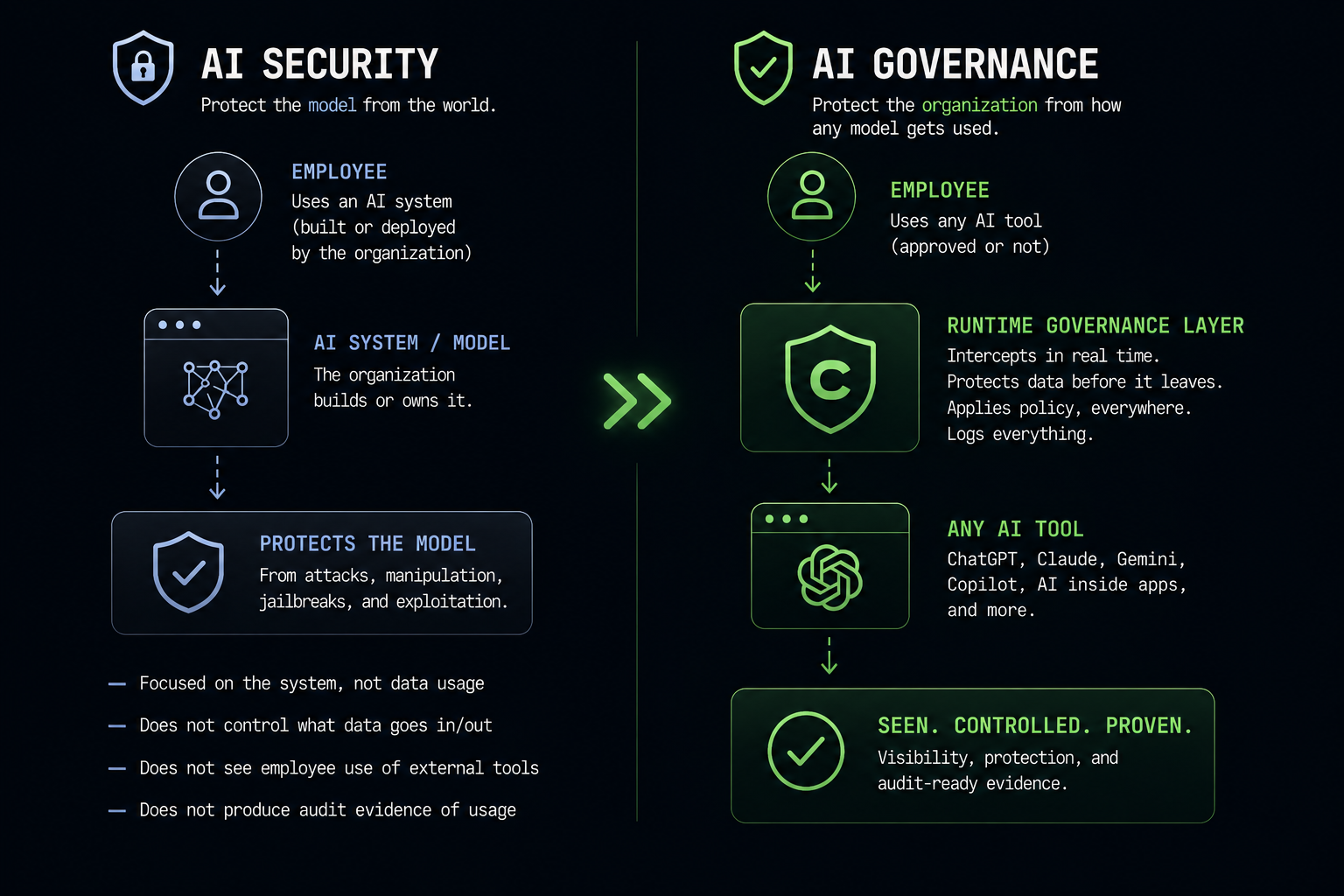
Vendor pitches use "AI governance" and "AI security" almost interchangeably, and that's a problem, because they're answers to different questions. Confusing them leads directly to a specific, expensive mistake: buying a well-reviewed AI security product and discovering, months later, that it was never going to solve the compliance gap that actually mattered.
Two different questions
AI security asks: is this AI system safe from attack? Can it be jailbroken, manipulated into leaking its training data, tricked into ignoring its safety instructions, or exploited through adversarial inputs? It's a discipline focused on the model and the application built around it — protecting the system from people trying to break it.
AI governance asks a different question entirely: what happens to our organization's data when our employees use any AI system, whether we built it or not? It's not about hardening a model against attack. It's about controlling what flows into and out of AI tools, and being able to prove that control existed when someone asks.
A useful way to hold the distinction: AI security protects the model from the world. AI governance protects the organization from how the model — any model — gets used.
Why the confusion is expensive
The practical cost shows up in procurement. A security team evaluating "AI protection" vendors often ends up comparing tools that don't actually solve the same problem, because both get pitched under similar language.
An AI red-teaming platform or prompt-injection defense tool is primarily an AI security product — it protects an AI system your organization has built or deployed from being attacked or manipulated. Some LLM firewalls sit across both categories, depending on whether they protect the model itself, govern enterprise data flows, or do both. None of these necessarily do anything about an employee pasting a client contract into the public ChatGPT interface, because that isn't an attack on a model. It's an ungoverned data flow to a model your organization doesn't control at all.
Conversely, an organization can have zero AI security concerns — no custom models, no in-house AI product — and still carry enormous AI governance exposure, purely from employees using consumer AI tools with company data. Company size or technical sophistication has nothing to do with which category of risk applies; usage pattern does.
Where the two genuinely overlap
They're not unrelated. Organizations that build or fine-tune their own AI products need both: security to protect the model itself from adversarial misuse, and governance to control what data reaches it and what happens to the outputs. A company running a customer-facing AI chatbot, for instance, needs security controls against prompt injection and governance controls over what data that chatbot can access and log.
But most regulated enterprises today aren't building AI products.
Colchix gives regulated enterprises real-time visibility into shadow AI usage — which tools, which employees, which data — before it becomes a compliance incident.
See how ARGUS works →