Shadow AI Detection: How to See What Your Team Actually Uses
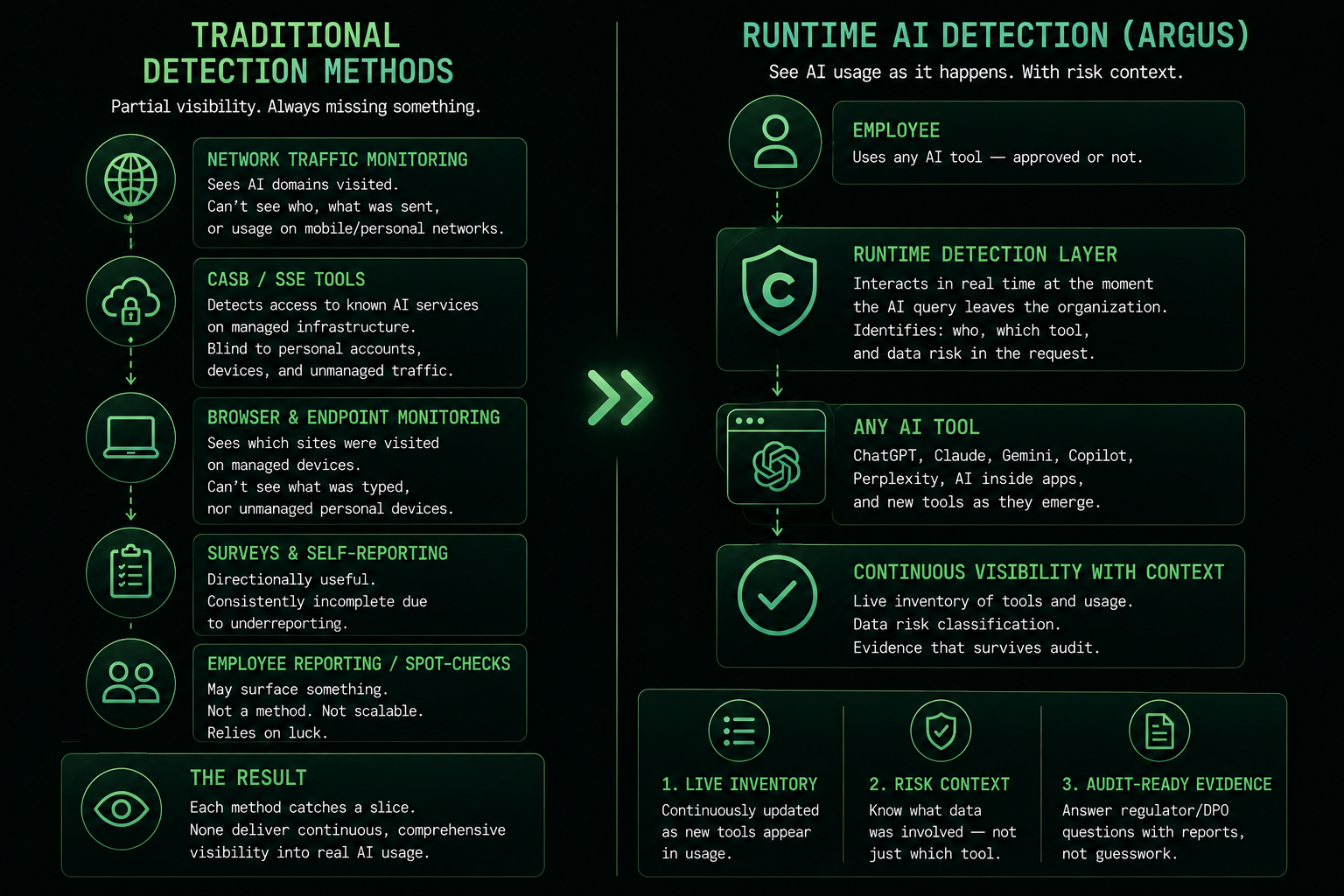
Every conversation about shadow AI eventually arrives at the same practical question: fine, employees are using unapproved AI tools — how do you actually find out which ones, and who's using them? The honest answer is that most detection methods only catch part of the picture, and knowing which part each one misses is the difference between a security team that thinks it has visibility and one that actually does.
Why this is harder than detecting shadow IT
Traditional shadow IT detection relied on signals that AI usage often doesn't produce. An unapproved SaaS tool usually needed an account with a company email, a browser extension install, sometimes an expense report. Each of those left a trace somewhere a security team could look.
AI usage frequently leaves none of that. An employee can open ChatGPT in an incognito tab, log in with a personal Gmail account, and never touch anything the organization's identity provider or endpoint tooling would notice. No install. No corporate SSO. No expense line. The interaction happens entirely inside a browser session that, from the network's perspective, looks like ordinary web traffic to a domain that isn't inherently suspicious.
This is why "we'll just check our approved software list" — the default first move for most IT teams — catches almost nothing. It only shows what was approved, which by definition excludes everything shadow AI actually is.
The detection methods that exist, and what each one misses
Network traffic monitoring. Inspecting DNS requests or traffic patterns to known AI domains (chat.openai.com, claude.ai, gemini.google.com, and dozens more) can reveal that someone on the network visited those domains. What it typically can't reveal: which employee, what they sent, or whether the visit happened on a personal device using mobile data instead of the corporate network — which is exactly what happens once employees learn the network is being watched.
CASB (Cloud Access Security Broker) and modern SSE platforms. Increasingly capable of detecting access to known GenAI services and applying useful access controls, and several major vendors are actively adding GenAI-specific discovery. The limitation is depth, not absence: identifying that a user accessed an AI service is different from understanding the AI interaction itself — classifying the data involved, and producing AI-specific governance evidence rather than a network access log entry.
Browser extension and endpoint monitoring. Can log which sites an employee visited on a managed device, which is genuinely useful — but says nothing about what was typed into the page, and nothing at all about unmanaged personal devices, which employees increasingly prefer specifically because they aren't monitored.
Self-reported surveys. Asking employees to disclose which AI tools they use produces data that's directionally useful and reliably incomplete — people underreport tool use they suspect isn't sanctioned, not out of dishonesty, but because admitting it feels like admitting a policy violation, even when the actual violation is the absence of a sanctioned alternative.
Employee reporting or spot-checks. Occasionally surfaces something real, but isn't a detection method — it's luck, and it doesn't scale past a handful of incidents.
Each of these catches a slice. None of them, alone or combined, produces continuous, comprehensive visibility — because they were all built to answer a narrower question than the one that actually matters: not "did traffic hit this domain" but "what AI tool did this specific employee use, with what data, and when."
What actual runtime detection looks like
The gap all of the above share is timing and scope: they're either reactive (checking logs after the fact) or partial (only seeing managed devices, or only network-level traffic without content). This means the detection layer sits at the point where the AI query actually leaves the organization's perimeter — not watching for a domain name to appear in a log, but actively identifying the interaction: which employee, which AI tool, what category of data is in the request.
Runtime detection closes these gaps by observing AI interactions as they occur across the environments under organizational control — managed devices, corporate network and proxy traffic, browser-level visibility where deployed — rather than relying solely on retrospective logs or a static list of approved applications. Detection shouldn't depend exclusively on a known-tools list either: a runtime layer can combine known-tool identification with behavioral and traffic signals to surface AI usage as it happens, including tools that launched last month and don't appear on anyone's approved list yet.
The practical difference this makes: a new AI tool doesn't need to be added to a blocklist or an approved-tools list to be visible within the organization's controlled environment. It gets surfaced as usage occurs, not months later when someone happens to notice.
What good shadow AI detection actually delivers
Three things, together, not any one alone:
- A live inventory, not a point-in-time snapshot — continuously updated as new tools appear in usage, not refreshed on a quarterly audit cycle that's already stale by the time it's reviewed.
- Risk context, not just a tool list. Knowing that 40 employees use ChatGPT is less useful than knowing which of those sessions involved something resembling client contract language or financial figures. Detection without risk signal produces a long list nobody has time to act on.
- A record that survives being asked about. If a DPO or a regulator asks what AI tools processed personal data in the last quarter, the answer needs to be a report pulled from continuous monitoring, not a reconstruction assembled from partial network logs and guesswork.
What this means in practice
Detection is the precondition for everything else in AI governance, not a nice-to-have layered on top. An organization can have well-designed data protection policies, solid tokenization tooling, and a clean audit process — and none of it matters for the AI usage it never saw happening in the first place. You cannot govern, protect, or produce evidence about an interaction that never registered anywhere.
This is also why detection alone, without action, is an incomplete answer. Seeing that an employee used an unapproved tool with sensitive data is useful. Seeing it and being able to protect that data before it left the organization — in the same moment, not after a security team reviews the log a week later — is the actual goal. Detection tells you what's happening. It's the first of three capabilities, not a finish line.
Colchix's ARGUS module gives regulated enterprises continuous, real-time visibility into AI usage across their environment — including approved and shadow AI — with risk context that goes beyond a simple list of domains visited.
See how ARGUS works →