AI Data Leakage: How Sensitive Data Actually Reaches LLMs
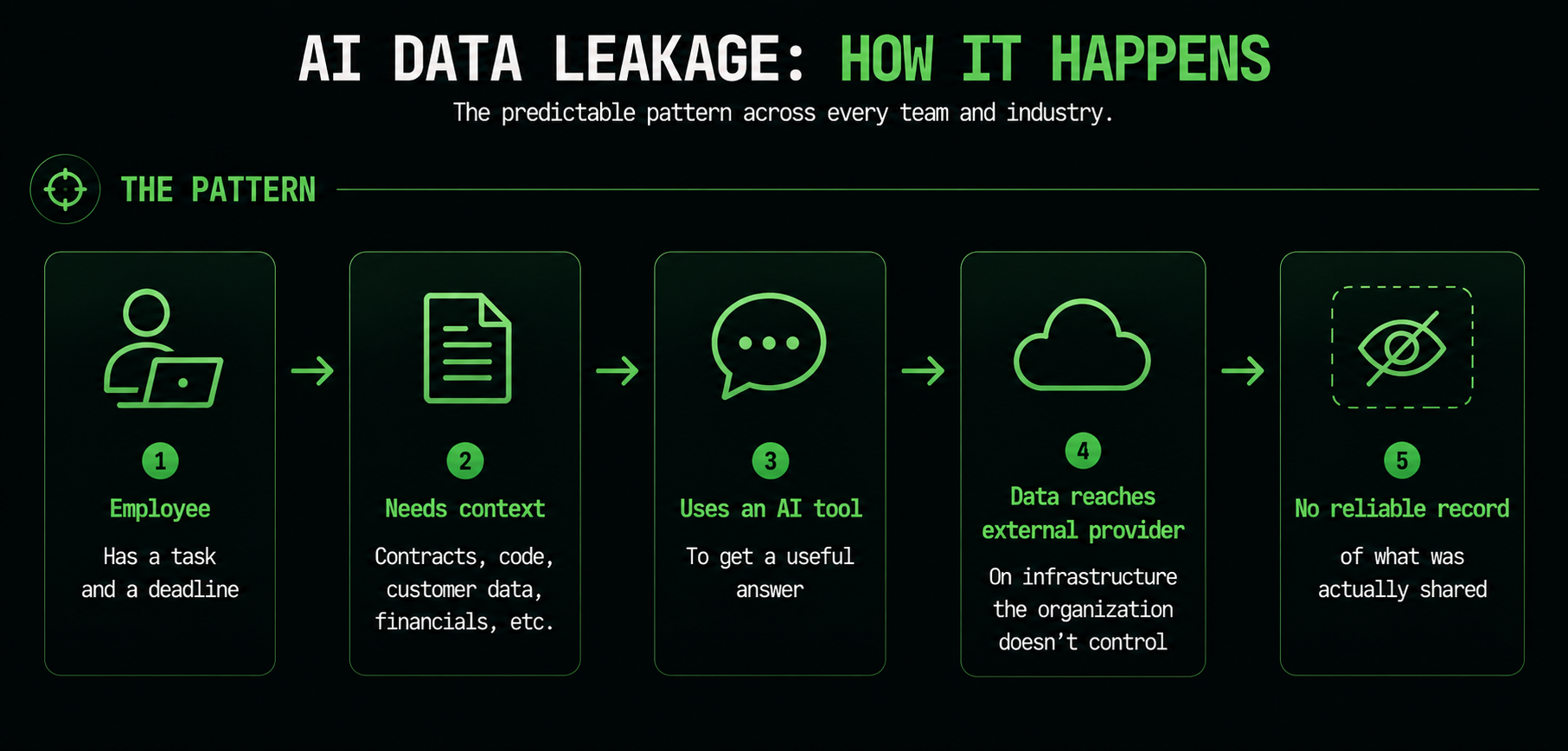
AI data leakage doesn't usually happen the way security awareness training implies — a careless click, a phishing link, a deliberate insider threat. It happens through completely legitimate work, performed by employees trying to do their job faster, using tools that make that entirely possible in a way no previous generation of software did. Understanding the actual pattern matters more than imagining a dramatic breach scenario, because the real pattern is what security controls need to be built around.
The pattern, not the exception
Across regulated industries, the shape of AI data leakage repeats with remarkable consistency: an employee has a task, a deadline, and an AI tool that can plausibly help. The task requires context — a contract, a customer record, source code, financial figures — so the employee provides that context to get a useful answer. The AI tool now has data it was never meant to receive, on infrastructure the organization doesn't control, and there may be no reliable record inside the organization of what was actually shared.
This isn't a security failure in the traditional sense — nobody circumvented a firewall or exploited a vulnerability. It's a gap between what the AI tool needs to do its job well and what the organization is actually authorized, contractually or legally, to hand over. That gap is invisible until something goes wrong, and by the time it's visible, the data has already left.
What this looks like across functions
Legal and contracts. An in-house counsel pastes a draft NDA into ChatGPT to check the language against a template, including the counterparty's name, deal terms, and confidentiality clauses that explicitly prohibit sharing the document outside the immediate deal team. The AI tool wasn't part of that team, and nobody assessed whether the transfer breached the confidentiality clause itself.
Customer support. An agent pastes a customer's full support ticket — name, account details, sometimes payment or health information depending on the industry — into an AI tool to draft a more polished response. The customer's personal data, protected under GDPR, now sits on a third-party AI provider's infrastructure, potentially processed outside the safeguards, purposes, and vendor arrangements the organization originally established for that data.
Engineering. A developer copies a proprietary code snippet, sometimes including embedded API keys or internal architecture details, into an AI coding assistant to debug an issue under deadline pressure. Source code is intellectual property; depending on the tool and its terms, that snippet may now be retained on infrastructure outside the organization's control.
Finance. An analyst feeds unreleased quarterly figures into an AI tool to help draft internal commentary or check the phrasing of an earnings summary. For public companies, this touches material non-public information — a category with regulatory consequences well beyond a typical data protection concern.
HR. A manager uploads employee performance reviews or compensation data to an AI tool to help draft feedback more diplomatically, believing the data is anonymized enough to be safe. It rarely is — names, role titles, and specific project references usually make individuals identifiable even without an explicit name attached.
None of these employees intended to cause a data protection incident. Each one was solving a real problem with the tool that happened to be available and effective.
Why the leakage often goes undetected
Three structural reasons this pattern persists without organizations noticing:
No transfer event looks unusual. Traditional data loss prevention tools were built to catch large file transfers, unusual download volumes, or data leaving through recognizable exfiltration channels. A conversational AI prompt doesn't necessarily resemble traditional exfiltration. It can be a few paragraphs typed into an ordinary browser session — far less obvious than a bulk download or large file transfer.
The employee doesn't experience it as a data transfer. Psychologically, typing into a chat interface feels like asking a question, not like sending a file to an external party. The interface feels conversational. The underlying event is still data leaving one environment and entering another. That framing gap matters, because it means employees who would think twice before emailing a contract to an unknown address don't apply the same caution to an AI chat window, even though the underlying data movement is comparable.
No one is looking at content, only access. Most existing monitoring tools that do see AI tool usage — CASB platforms, endpoint monitoring — see that a domain was visited, not what was actually sent. Confirming an employee visited chat.openai.com tells you nothing about whether they pasted a customer's medical record or asked a general question about email etiquette. Without visibility into the content of the exchange, there's no way to distinguish routine, harmless use from an actual leakage event.
Why the compliance exposure compounds
A single instance of AI data leakage is a real but often limited risk. What makes it a serious ongoing exposure is that it doesn't stay a single instance — it repeats across every employee who discovers the same shortcut, at a scale that individual incident response can't keep pace with.
Under GDPR, each unassessed transfer to an external AI service is a potential accountability gap — an organization is expected to have assessed the lawful basis and cross-border implications of processing before it happens, not after a regulator asks. Under sector-specific confidentiality obligations — attorney-client privilege, doctor-patient confidentiality, banking secrecy — the exposure isn't just regulatory; it can undermine the legal protections those relationships depend on. And practically, an organization that can't say with confidence what data has and hasn't reached external AI tools has no reliable way to scope a breach notification if something does go wrong later — the uncertainty itself becomes a liability.
What actually catches this before it happens
The three structural gaps above point directly to what a real defense needs to address, together:
- Visibility into content, not just access. Knowing an AI tool was used matters less than knowing what category of data was involved — the difference between a harmless question and a leakage event.
- Protection that intervenes before the transfer completes, not detection that flags it afterward. By the time a leakage event is logged after the fact, the data has already reached the external tool — the record is useful for audit, but it didn't prevent the exposure.
- A control that doesn't depend on the employee recognizing the moment as risky. Since the psychological framing of a chat query doesn't feel like a data transfer, the control can't rely on the employee pausing to think about it — it has to operate regardless of whether they do.
The bottom line
AI data leakage isn't an edge case requiring an unusual set of circumstances — it's the predictable outcome of giving employees fast, effective tools without a technical layer that understands what's actually flowing through them. The pattern is consistent enough across industries and functions that it's less useful to think of it as a series of incidents to respond to, and more useful to treat it as a structural gap to close — one that exists the moment an AI tool has access to a browser and an employee has a deadline.
Colchix's Golden Fleece module tokenizes sensitive data in real time before it reaches any external AI tool — closing the gap between what employees need to get work done and what actually leaves the organization.
See how it works →