AI Audit Trail: What Regulators Actually Ask For
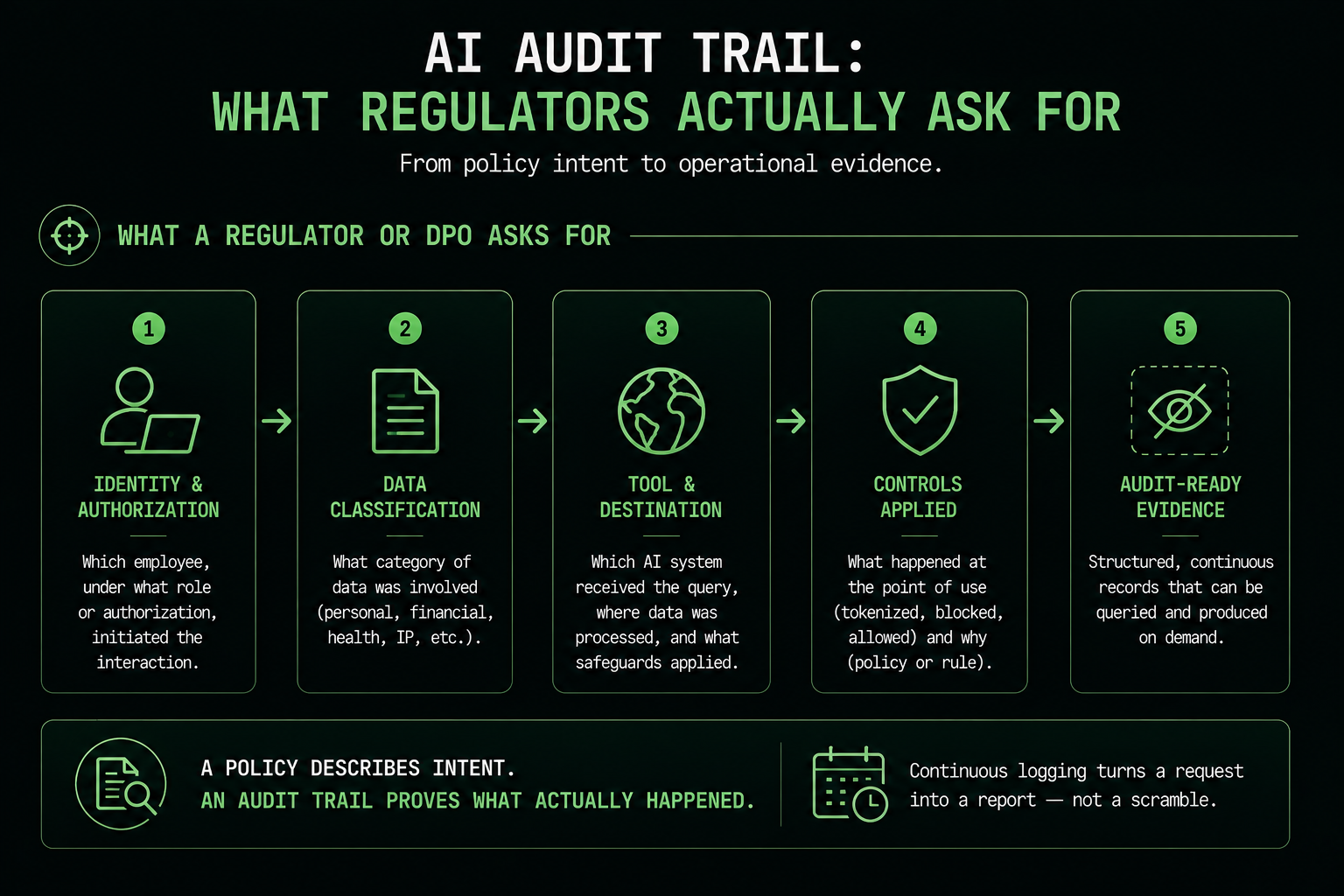
The moment a DPO or regulator asks "show me what AI systems processed personal data in the last quarter, and how you controlled that," most organizations discover the gap between having a governance policy and having governance evidence. A policy describes intent. An audit trail is evidence of what happened, and building one after the fact — reconstructed from memory, Slack messages, and partial logs — is not the same thing as having had one running.
What "audit trail" actually means here
An AI audit trail is a structured, continuous record of AI activity within an organization: which employee used which tool, what category of data was involved, when it happened, and what controls applied. It's not a single document — it's a live dataset, built automatically as AI interactions occur, retained in a form that can be queried and produced on demand.
The distinction that matters: an audit trail is evidence of what happened, not a description of what should happen. A signed AI usage policy, a training deck, a list of approved tools — these describe intent, and regulators generally aren't asking for intent. They're asking for demonstrated behavior. A reliable audit trail is what turns that answer from a policy claim into operational evidence.
What a regulator or DPO actually asks for
Requests vary by framework and context, but they converge on a consistent set of underlying questions:
- Which AI systems processed personal data, and for what purpose? Not a list of approved tools — an actual record of use, including tools nobody formally approved.
- What categories of data were involved? Personal data, special category data, financial information, health records — the specific classification matters for assessing severity and scope.
- Under what authorization, purpose, and governance framework did the processing occur? GDPR accountability requires organizations to connect processing activity to an established purpose, lawful basis, and appropriate controls — not simply state that an employee chose to use the tool.
- What technical and organizational measures were in place? This is where AI Act oversight requirements and GDPR Article 25/30 obligations converge — evidence of controls, not just evidence of intent to have controls.
- Can you demonstrate this wasn't an isolated incident review, but continuous practice? A one-time audit conducted after a complaint looks very different, credibility-wise, from a system that has been logging this continuously all along.
None of these are satisfied by a policy document, however well-written. Each requires an actual record.
Why "we have a policy" fails as an answer
A policy answers "what were employees told to do." None of the questions above ask that. They ask what actually happened, to whom, with what data, under what authority — questions a policy document has no mechanism to answer, because a policy doesn't observe anything. It states an intention and stops.
This gap becomes acute specifically during an investigation, because investigations happen after something already occurred — the organization needs to explain a specific past event, not a general intention. "Our policy prohibits pasting client data into unapproved AI tools" is not an answer to "did that happen, and if so, when, by whom, and with what data." Only a log can answer that question, and only if the log existed before the question was asked.
What a defensible audit trail actually needs to contain
Four components, consistently, across GDPR and AI Act contexts — WHO used AI, WHAT category of data was involved, WHERE it was sent, WHAT CONTROL was applied:
- Identity and authorization. Which employee, under what role or authorization, initiated the interaction — not anonymized activity, but attributable, auditable records.
- Data classification. What category of data was involved — not necessarily the full content of every prompt, but enough classification (personal data, financial, health, IP) to assess exposure and regulatory relevance without unnecessarily exposing prompt contents themselves.
- Tool and destination. Which AI system received the query, where the data was processed, and what relevant transfer and data-processing safeguards applied.
- Controls applied. What happened at the point of use — was sensitive data tokenized, blocked, allowed through unmodified — and why, mapped to the policy or rule that triggered that outcome.
Missing any one of these turns the record into a partial answer. A log of "AI tool used" without data classification tells a regulator nothing about severity. A log of data classification without identity and authorization can't establish accountability. The four need to exist together, consistently, not as four separate systems that happen to overlap.
Why retroactive reconstruction doesn't hold up
When an organization gets asked for evidence it doesn't already have, the common response is trying to reconstruct it after the fact — pulling together whatever partial logs exist (network access records, ticketing systems, employee interviews) into something that resembles an answer.
This approach has a structural credibility problem beyond simple incompleteness: a reconstructed record, assembled specifically in response to a request, invites the question of whether it's complete, accurate, or shaped by hindsight. A continuous log that existed independently of any specific request — generated automatically as a byproduct of normal operation, not compiled defensively after the fact — carries fundamentally different evidentiary weight. Regulators and auditors are generally aware of this distinction, even when it isn't stated explicitly in a request.
The cost of missing evidence isn't limited to regulatory exposure. It turns audits into manual investigations, pulls Security, Legal, and IT into evidence collection, and makes incident scope harder to establish precisely — a cost measured in weeks of internal time, not just potential fines.
How this connects to runtime governance
An audit trail isn't a separate system bolted onto AI governance — it's the natural output of governance operating correctly. If visibility, protection, and control are genuinely happening at the point of use (the runtime layer), the audit trail is simply the record of that activity, generated as a byproduct rather than assembled as a separate compliance project.
This is why organizations that try to build "just the audit trail piece" without the underlying runtime visibility and protection tend to end up with a log of access events — who visited what domain — rather than a log of governed AI activity. The audit trail is only as good as what the underlying system actually saw and controlled. A log can't document protection that never happened.
The bottom line
When the question is "what did your AI systems actually do," a policy is not evidence, and a log built after the request is not the same as a log that already existed. A defensible AI audit trail is continuous, attributable, classified, and generated automatically as normal operation — not assembled under pressure once someone asks. Building that infrastructure before it's needed is the difference between answering a regulator's question with a report and answering it with a scramble.
Colchix's Athena module generates continuous, audit-ready evidence — identity, data classification, destination, and controls applied — for every AI interaction across your organization, before a regulator ever has to ask.
See how it works →