System One AI for Enterprise: Governance, Security and Real-Time Decision Use Cases
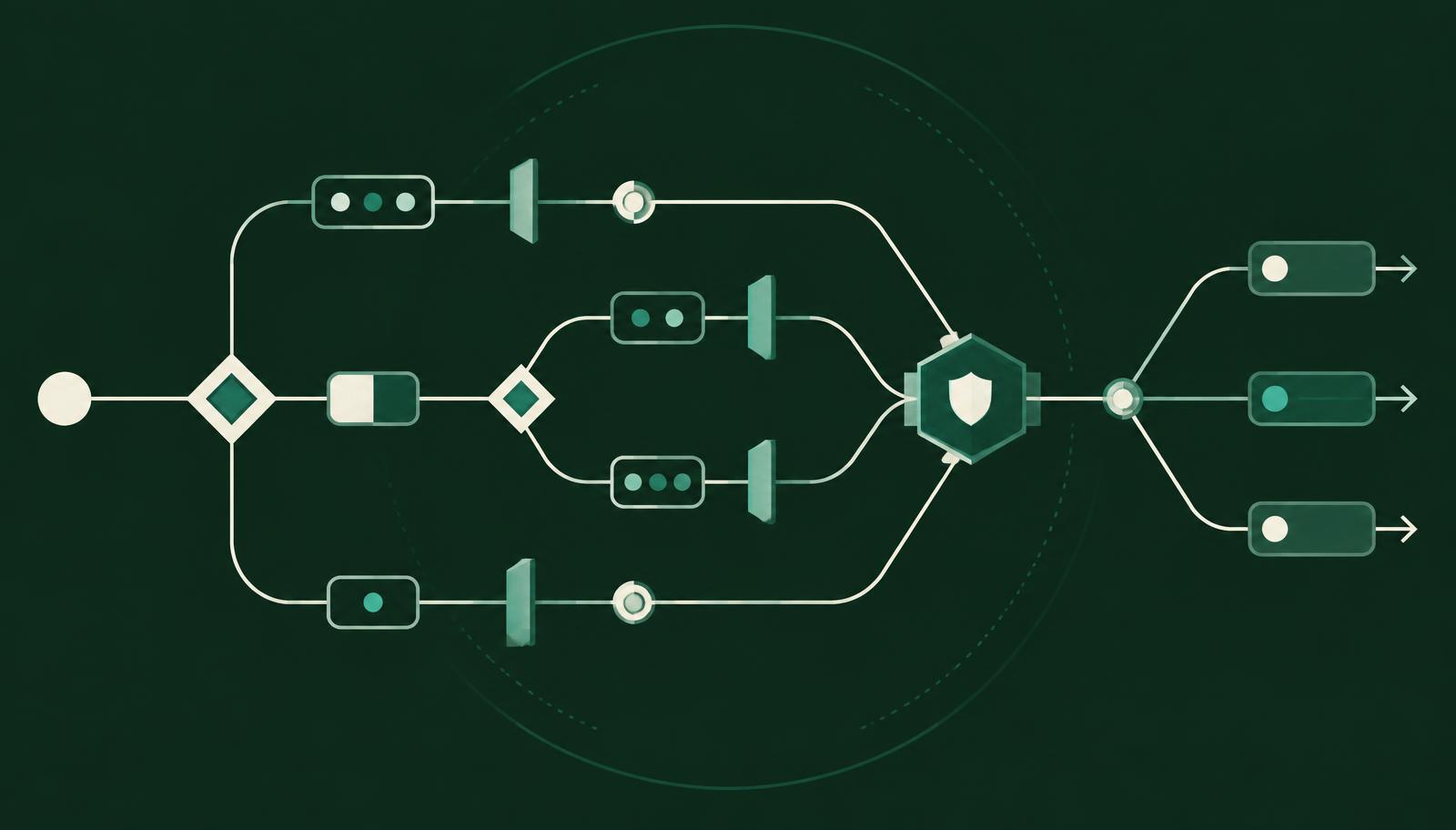
System One AI models are designed to make fast, structured decisions inside software rather than generate open-ended text for people. In enterprise environments, that makes them particularly relevant for workflows such as classification, routing, risk scoring, security checks, sensitive-data detection and policy enforcement.
The category is new. Jev, introduced by TypeSafe AI in September 2026, is the first public model explicitly positioned as a System One model. TypeSafe describes System One models as machine-native models that return typed decisions with probabilities and confidence rather than free-form strings. For background on Jev itself, see our explainer on what Jev is and how System One models differ from LLMs. This article focuses on something different: where System One AI fits in enterprise workflows, and what it takes to govern and secure it.
In short
- System One models return structured decisions rather than free-form text.
- They are designed to sit directly inside software workflows and automation.
- Useful enterprise tasks include classify, route, score, detect, verify and gate.
- Governance becomes especially important when AI decisions trigger automated actions.
What is System One AI?
System One AI describes models designed primarily for machine-consumable decisions rather than open-ended conversation. Instead of writing a paragraph that a person (or another program) has to interpret, a System One model answers a question whose possible outputs are defined in advance: pick one of these categories, give a score, return yes or no.
A few characteristics define the category:
- Machine-oriented output. The answer is designed to be consumed by software, not read by a human.
- Predefined output types. The shape of the answer — a label, a number, a boolean — is fixed before the model is called.
- Probabilities and confidence. The model can return how likely each answer is, not just the answer itself.
- Direct consumption. Because the output is typed, code can act on it without parsing generated text.
- Fast inference. Small, bounded outputs can make real-time workflows practical.
Jev is currently the public example of this emerging category. TypeSafe AI makes specific claims about Jev’s speed, cost and calibration; those are TypeSafe’s claims, and enterprises should evaluate them against their own tasks.
System One AI vs traditional LLM workflows
| Dimension | Traditional LLM | System One model |
|---|---|---|
| Primary output | Generated text | Typed decision |
| Main consumer | Human or agent | Software |
| Integration | Parse/validate generated output | Structured output defined in advance |
| Typical task | Generate, explain, converse | Classify, score, route, verify |
| Uncertainty | Often implicit | Can be returned explicitly as probability/confidence |
| Workflow role | Flexible reasoning/generation | Decision component inside code |
One important caveat: System One models are not replacements for LLMs in every task. They are better understood as a different AI primitive for situations where software needs a bounded decision rather than generated content.
Where System One AI fits in enterprise workflows
The most useful way to think about System One AI is as a decision component that sits at specific points in a workflow. The examples below are illustrative; each one still needs to be evaluated for accuracy on the organisation’s own data.
Classification and routing
Many enterprise processes start with a question of “what is this, and where should it go?” Examples include:
- routing support tickets to the right team;
- classifying incoming business requests;
- selecting the next step in a workflow;
- deciding which system or model should handle a request.
Risk scoring and escalation
Scores with confidence make it easier to decide what needs attention. Examples include:
- assigning risk levels to transactions, requests or events;
- deciding whether an event needs human review;
- escalating low-confidence decisions;
- prioritising alerts.
Sensitive-data detection
A decision model can be used to answer a narrow question before content moves further: does this text contain personal data, confidential business information, credentials or other protected data? If the answer is yes, the surrounding system can apply controls before another model — for example an external LLM — ever receives the content.
This is a use case, not a built-in feature of the category. Not every System One model provides sensitive-data detection; a model has to be built and evaluated for that task.
AI security and guardrails
As more AI is embedded in products and internal tools, security teams need fast checks around AI interactions. Examples include:
- assessing prompts or outputs;
- detecting suspicious or disallowed interactions;
- deciding whether an AI request should proceed;
- verifying another model’s output;
- triggering additional controls.
AI agent governance
AI agents propose and take actions. A decision layer can sit between the proposal and the action. Examples include:
- approving or rejecting proposed actions;
- routing agent decisions;
- setting confidence thresholds for autonomous action;
- requiring human review for uncertain or sensitive actions.
Large-scale data processing
Some tasks involve applying the same decision to millions of records: labelling documents, flagging records for review, or checking data against a policy. Free-form generation is often unnecessarily expensive for this and produces output that is harder to integrate. A structured decision, applied repeatedly, fits the job more naturally and can be written straight into a database or pipeline.
Why confidence matters in enterprise automation
A decision is more useful operationally when software knows not only the answer but also how certain the model is. Confidence turns a single answer into a policy choice:
- High confidence → proceed automatically;
- Medium confidence → apply additional checks;
- Low confidence → send to human review.
This only works if confidence is meaningful. For a well-calibrated model, predictions made at roughly 90% confidence should be correct at roughly that rate over a sufficiently large set of comparable cases. TypeSafe explicitly positions Jev around calibrated probabilities and confidence; its reasoning is set out in its official introduction to System One models and Jev. As with any vendor claim, calibration should be tested on the decisions an organisation actually needs to make.
System One AI for governance and security
The key point is simple: the closer AI gets to directly controlling software workflows, the more important governance becomes. When a model’s output is read by a person, that person acts as an informal check. When a typed decision flows straight into code, there may be no one looking before something happens.
Operationally, that means organisations need clear answers to questions such as:
- who defines the decision boundaries and the allowed outputs;
- which models are approved for which decisions;
- what data the decision model can access;
- which confidence thresholds allow autonomous action;
- when and how decisions are escalated to humans;
- how decisions are logged for audit;
- how model and policy versions are tracked;
- how false positives and false negatives are monitored;
- what evidence shows why a particular control fired.
For the regulatory angle — roles, intended purpose and high-risk use cases — see Jev and the EU AI Act.
System One AI and real-time data protection
One concrete architecture shows how a decision model can protect data in real time:
- An employee or application sends a prompt or request.
- A fast decision model inspects the relevant content.
- It identifies sensitive elements or determines whether controls are required.
- The system masks, tokenizes, blocks or routes the request according to policy.
- The underlying AI application receives only the permitted content.
This is one possible System One architecture, not a capability automatically provided by every System One model. The choice between masking techniques matters too — see tokenization vs redaction — and the broader pattern of enforcing policy at the moment of use is covered in runtime AI governance.
When should enterprises use System One AI instead of an LLM?
Use a System One model when:
- the possible outputs are known in advance;
- software must act on the answer;
- low latency matters;
- the task is repeated frequently;
- uncertainty needs to be quantified;
- a deterministic output structure is important.
Prefer an LLM when:
- the output needs to be open-ended;
- generation, explanation or conversation is the goal;
- the task requires long-form synthesis;
- a human is expected to interpret the response.
Many enterprise systems will use both: a System One model to decide, route and gate, and an LLM to generate where generation is genuinely needed.
What enterprises should evaluate before adopting a System One model
- accuracy for the specific decision task;
- calibration and confidence quality;
- latency;
- cost at production scale;
- type and schema guarantees;
- data handling and retention;
- deployment location;
- integration model;
- observability;
- versioning;
- human escalation;
- security;
- governance evidence.
Jev and the emergence of System One models
TypeSafe AI introduced Jev as its first public System One model and positions it around workflows such as classification, routing, scoring, extraction, verification, guardrails and real-time applications. These are TypeSafe’s descriptions of its model.
We cover Jev in more depth elsewhere:
- What Is Jev? System One Models vs LLMs Explained
- Jev and the EU AI Act
- Can European Enterprises Use Jev?
- Is There a European Alternative to Jev?
THEMIS and System One² for European enterprise governance
Colchix is developing THEMIS, its System One² model focused initially on enterprise AI governance and sensitive-data protection.
The intended direction includes:
- fast governance decisions;
- sensitive-data detection;
- runtime controls;
- European deployment;
- privacy-oriented infrastructure;
- integration into Colchix’s governance platform.
THEMIS is under development. These are development goals, not generally available capabilities, and THEMIS does not carry any regulatory certification or guarantee of compliance. Read more in Introducing THEMIS.
Frequently asked questions
What is a System One AI model?
A System One AI model is a model designed to return fast, structured decisions — such as a category, a score or a yes/no probability — that software can act on directly, rather than generating open-ended text for people to read.
What is System One AI used for?
System One AI is suited to bounded decision tasks inside software: classification, routing, risk scoring, security checks, sensitive-data detection, verification and policy enforcement.
Is Jev a System One model?
Yes. TypeSafe AI introduced Jev in September 2026 and positions it as the first public model explicitly described as a System One model.
Is System One AI better than an LLM?
Not in general. System One models are a different AI primitive for tasks where software needs a bounded decision. LLMs remain better suited to open-ended generation, explanation, conversation and long-form synthesis. Many enterprise systems will use both.
Can System One AI be used for security?
Yes, it can be used as a decision component in security workflows — for example to assess prompts or outputs, detect suspicious interactions or decide whether a request should proceed. Its effectiveness depends on the specific model and how it is evaluated for the task.
Can System One AI govern AI agents?
It can support agent governance by approving or rejecting proposed actions, routing decisions and applying confidence thresholds, with uncertain or sensitive actions escalated to human review. The governance rules themselves still need to be defined and owned by the organisation.
Can System One models detect sensitive data?
A System One model can be used to decide whether content contains personal data, confidential information or credentials, if it has been built and evaluated for that task. Not every System One model automatically provides this capability.
What is the difference between Jev and THEMIS?
Jev is TypeSafe AI’s public System One model. THEMIS is the System One² model Colchix is developing, focused initially on enterprise AI governance and sensitive-data protection for European organisations. THEMIS is under development.
Sources
Claims about Jev’s performance, speed, cost and calibration are attributed to TypeSafe AI. Colchix is not affiliated with or endorsed by TypeSafe AI.