Runtime AI Governance: Why Policies on Paper Don't Stop Anyone
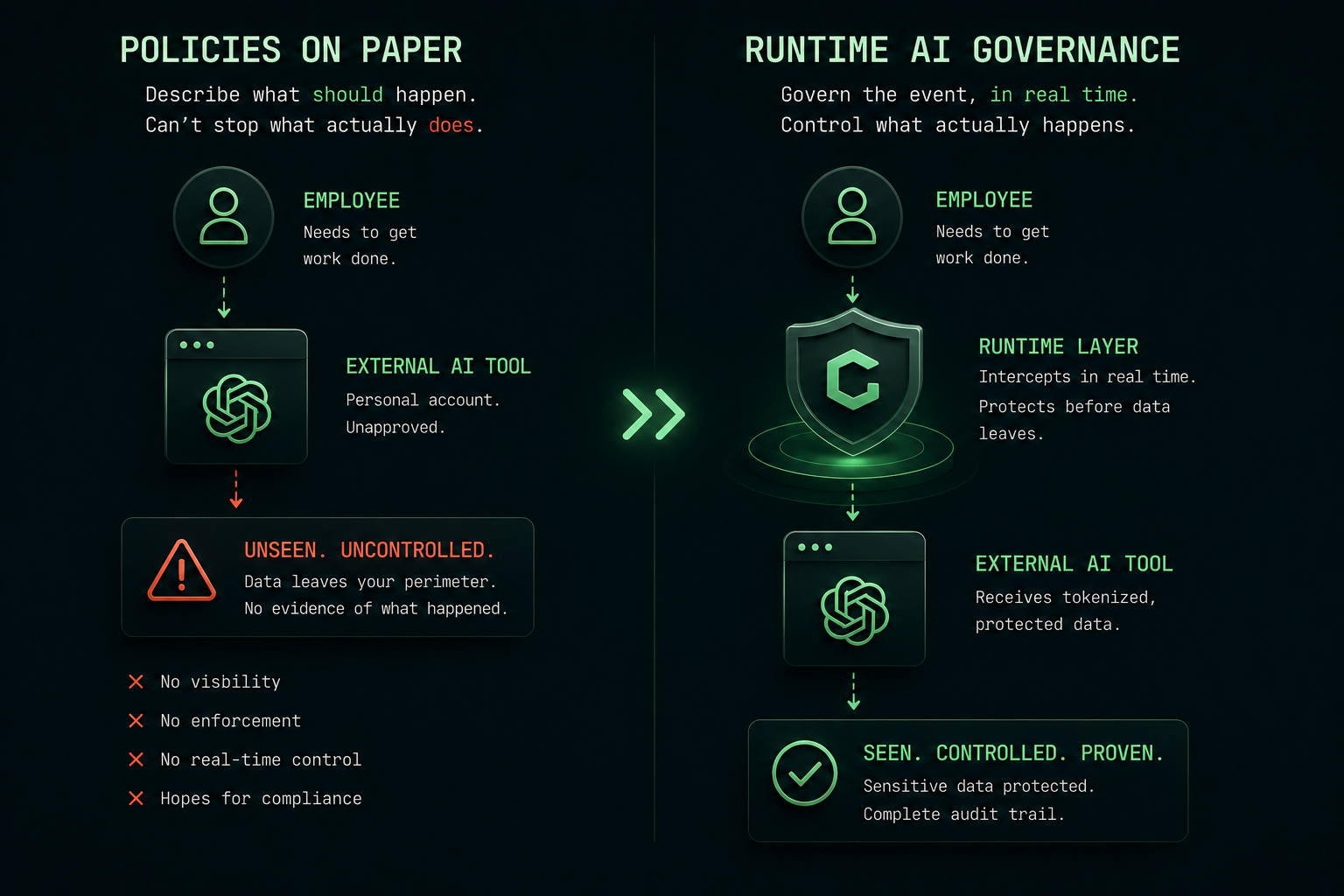
Every organization with an AI usage policy has the same evidence problem: the policy describes what should happen, and nothing describes what actually did. Runtime governance closes that gap — not by writing a better policy, but by moving control from a document to the moment the AI system is actually used.
The policy was never the control
An AI acceptable-use policy typically says something like: employees must not input confidential, personal, or proprietary data into external AI tools without approval. Reasonable. Almost universally adopted. And almost universally ignored the moment it collides with a real deadline, because a policy has no mechanism to intervene — it can only ask, after the fact, why someone didn't follow it.
This isn't a training problem. Even employees who know the policy exists can violate it under normal work pressure, because in the moment, finishing the task is immediate while the policy feels abstract.
A policy governs intention. Runtime governance governs the event itself, as it happens.
What "runtime" actually means here
Runtime governance means the control operates at the moment of use — when the employee opens the tool, types the query, and hits send — not at a scheduled review weeks or months later.
Concretely, that's the difference between two very different governance postures:
Periodic governance — a quarterly audit of approved AI tool usage, an annual policy re-signature, a survey asking employees to self-report what tools they use. All useful for documentation. None of it catches anything happening in real time, and all of it depends on people accurately reporting their own policy violations.
Runtime governance — the AI interaction is intercepted, evaluated, and governed as it occurs. Sensitive data is protected before it leaves the organization's perimeter, regardless of which tool the employee opened or whether it was on an approved list. The control doesn't need the employee to remember a rule, because the rule is enforced structurally, at the point of use.
Only one of these actually prevents the thing the policy was written to prevent.
Why periodic review structurally can't catch what runtime governance catches
The gap isn't a matter of frequency — reviewing more often doesn't fix it. It's a matter of what a review can see in the first place.
A quarterly access review can confirm which employees have accounts on approved tools. It cannot tell you what an employee pasted into ChatGPT last Tuesday on their personal account, because that event left no record anywhere a quarterly review would look. The absence of evidence isn't evidence of absence — it's evidence that nothing was watching at the time it mattered.
This is the same failure mode as trying to audit a data breach that happened three months before anyone noticed: the damage, if any, already occurred. Runtime governance doesn't just catch violations faster. It changes what's structurally possible to happen in the first place, because the control sits between the employee and the external model, not after both.
The three things runtime governance requires
This isn't a single feature — it's three capabilities operating continuously and together, at the moment of use, not the moment of review:
- Interception. The system needs to see the AI interaction as it happens — which tool, which employee, what's being sent — not reconstruct it later from logs that may not exist.
- Real-time protection. Sensitive data needs to be handled — tokenized, masked, blocked, whatever the policy requires — before it leaves the organization's control, not flagged for review after it already left.
- Continuous evidence. Relevant AI activity and control events need to be logged with enough context to demonstrate what happened — building the record automatically, without unnecessarily exposing prompt contents or employee data, rather than reconstructing it under pressure when someone asks for it.
Remove interception, and you're back to periodic self-reporting. Remove real-time protection, and you're logging violations instead of preventing them. Remove continuous evidence, and you have no way to prove any of it happened, even when it worked exactly as intended.
Why this matters more for AI than it did for previous technology waves
Organizations have lived with imperfect policy enforcement before — most companies never fully controlled what left on a USB drive or got pasted into personal email either. What's different with AI is the combination of frequency and stakes: the barrier to use is now zero (no install, no approval, just a browser tab), the tools improve constantly and expand what employees can do with them, and the categories of data involved — contracts, source code, client records, unreleased financials — sit exactly where a data protection authority or an auditor is most likely to look first.
A slow-moving, low-frequency risk tolerates periodic review reasonably well. A high-frequency, high-stakes one doesn't. Every week without runtime controls is another week of ungoverned exposure accumulating, not a static risk being managed.
What this looks like when it's working
Not a dashboard nobody checks. Three things happening simultaneously, invisibly, without requiring the employee to behave differently:
- An employee opens ChatGPT and pastes a client contract to draft a summary. The sensitive terms are tokenized before the query leaves the organization's perimeter — the employee gets a complete, accurate summary back, and never even notices the interception happened.
- A DPO is asked by a regulator to demonstrate what categories of personal data were processed by AI systems in the last quarter. The answer is a report generated from existing logs, not a scramble to reconstruct events from memory and Slack messages.
- IT discovers three new AI tools appeared in company usage this month that nobody approved — not through a survey, but because the runtime layer already saw them being used and logged it automatically.
None of these require employees to change how they work, remember a policy, or ask permission before using a tool that helps them move faster. That's not incidental — it's the actual design goal. Governance that requires behavior change to work is governance that will eventually fail when it collides with a deadline. Governance that operates at the infrastructure level doesn't have that failure mode.
The bottom line
A policy tells employees what they should do. Runtime governance makes sure the organization can see and control what actually happens, independent of whether anyone read the policy, remembered it, or chose to follow it under pressure. For AI specifically — fast-moving, zero-friction, touching the most sensitive data an organization holds — that distinction isn't a nice-to-have. It's the difference between governance that exists on paper and governance that exists at all.
Colchix operates at the runtime layer — intercepting AI usage as it happens, protecting sensitive data before it leaves your perimeter, and generating audit-ready evidence continuously.
See how it works →